
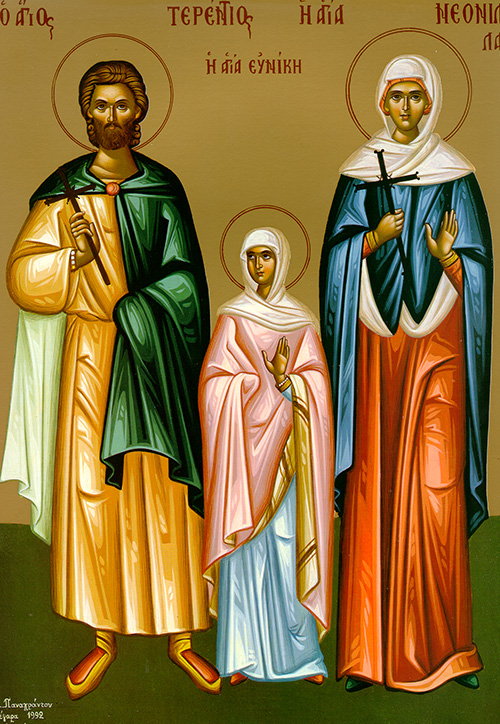
The holy martyrs Terence and Neolina were husband and wife from Syria, who were martyred with their seven children for their witness to Christ.
Our holy father Stephen the Sabbaite was the author of many beautiful canons. He lived in the community of St. Sabbas the Sanctified, near Jerusalem. He later became bishop, and died peacefully in 807.
The holy martyr Paraskevia of Iconium lived during the persecution of Diocletian. Paraskevia took a vow of celibacy and lived her life doing good works for the poor and needy in the name of Christ. She was arrested and taken before the governor. He had her tortured, flogged, and then beheaded in the 4th century.
Your martyrs, O Lord our God, in their struggle received incorruptible crowns from You. With Your strength, they brought down the tyrants and broke the cowardly valor of demons. Through their prayers, O Christ our God, save our souls.
Guide of Orthodoxy, mirror of piety snf exemplary behavior, bright star of the universe and adornment of monks, you enlightened us all by your teachings. O wise Stephen, inspired by God and lyre of the Holy Spirit, intercede with Christ God that He may save our souls.
Wise and all-praised martyress of Christ Paraskevia, you received masculine strength and rejected feminine infirmity, conquering the devil and shaming the torturer, crying out and saying: O come cut my body with the sword and burn it with fire, for rejoicing I go to my Groom Christ. Through these prayers, O Christ God, save our souls.
The honorable memorial of the martyrdom of Terence and his wife comes again today, filling us with joy as we gather to celebrate the feast. These two have received grace from the Holy Spirit to cure ills and heal our souls.
You planted a garden of virtues and watered it with your tears of repentance. Since you have found the Tree of Life, O all-glorious one , by your intercession save your flock from perdition and deliver from affliction those who honor you. O wise Stephen, we have chosen you in faith and love as our great intercessor.
You were offered the all holy and blameless torture, for a payment to the most pure, immortal Groom Christ, you gladdened a place in the angelic choir and you conquered the demonic snares. For this reason we honor you through faith, O Much-suffering Martyress Paraskevia.
2 Corinthians 6: 1-10
Brothers and sisters: As your fellow workers we beg you not to receive the grace from God in vain. For he says, “In an acceptable time I have heard you; on a day of salvation I have helped you.” Now is the acceptable time! Now is the day of salvation! We avoid giving anyone offense, so that our ministry may not be blamed. On the contrary, in all that we do we strive to present ourselves as ministers of God, acting with patient endurance amid trials, difficulties, distresses, beatings, imprisonments, and riots; as men familiar with hard work, sleepless nights, and fastings; conducting ourselves with innocence, knowledge, and patience, in the Holy Spirit, in sincere love as men with the message of truth and the power of God; wielding the weapons of righteousness with right hand and left, whether honored or dishonored; spoken of well or ill. We are called imposters, yet we are truthful; nobodies who in fact are well known; dead, yet here we are alive; punished, but not put to death; sorrowful, though we are always rejoicing; poor, yet we enrich many. We seem to have nothing, yet everything is ours!
Luke 7: 36-50
At that time there was a certain Pharisee who invited Jesus to dine with him. Jesus went to the Pharisee’s home and reclined to eat. A woman known in the town to be a sinner learned that he was dining in the Pharisee’s home. She brought in a vase of perfumed oil and stood behind him at his feet, weeping so that her tears fell upon his feet. Then she wiped them with her hair, kissing them and perfuming them with the oil. When his host, the Pharisee, saw this, he said to himself, “If this man were a prophet he would know who and what sort of woman this is that touched him–that she is a sinner.” In answer to his thoughts, Jesus said to him, “Simon, I have something to propose to you.” “Teacher,” he said, “speak.”
Jesus said, “Two men owed money to a certain money-lender; one owed a total of five hundred coins, the other fifty. Since neither was able to repay, he wrote off both debts. Which of them was more grateful to him?” Simon answered, “He, I presume, to whom he remitted the larger sum.” Jesus said to him, “You are right.”
Turning then to the woman, Jesus said to Simon: “You see this woman? I came to your home and you provided me with no water for my feet. She has washed my feet with her tears and wiped them with her hair. You gave me no kiss, but she has not ceased kissing my feet since I entered. You did not anoint my feet with perfume. I tell you, that is why her many sins are forgiven–because of her great love. Little is forgiven the one whose love is small.”
Jesus said to her then, “Your sins are forgiven”; at which his fellow guests began to ask among themselves, “Who is this that he even forgives sins?” Meanwhile Jesus said to the woman, “Your faith has been your salvation. Now go in peace.”
1 Thessalonians 2: 1-8
Brothers and sisters, You know well enough that our coming among you was not without effect. Fresh from the humiliation we suffered at Philippi – about what you know – we drew courage from our God to preach his good tidings to you in the face of great opposition.The exhortation we deliver does not spring from deceit or impure motives or any sort of trickery; rather, having met the test imposed on us by God, as men entrusted with the good tidings, we speak like those who strive to please God, “the tester of our hearts,” rather than men.
We were not guilty, as you well know, of flattering words or greed under any pretext, as God is our witness! Neither did we seek glory from men, you or any others, even though we could have insisted on our own importance as apostles of Christ.
On the contrary, while we were among you we were as gentle as any nursing mother fondling her little ones. So well disposed where we took you, in fact, that we wanted to share with you not only God’s tidings but our very lives, so dear had you become to us.
Luke 11: 9-13
The Lord said to his disciples: “Ask and you shall receive; seek and you shall find; knock and it shall be opened to you.’ For whoever asks, receives, whoever seeks, finds; whoever knocks, is admitted. What father among you will give his son a snake if he asks for a fish, or hand him a scorpion if he asks for an egg? If you, with all your sins, know how to give your children good things, how much more will the heavenly Father give the Holy Spirit to those who ask him.”
Icon courtesy of Jack Figel, Eastern Christian Publications – ecpubs.com
Tuesday, October 27 –