
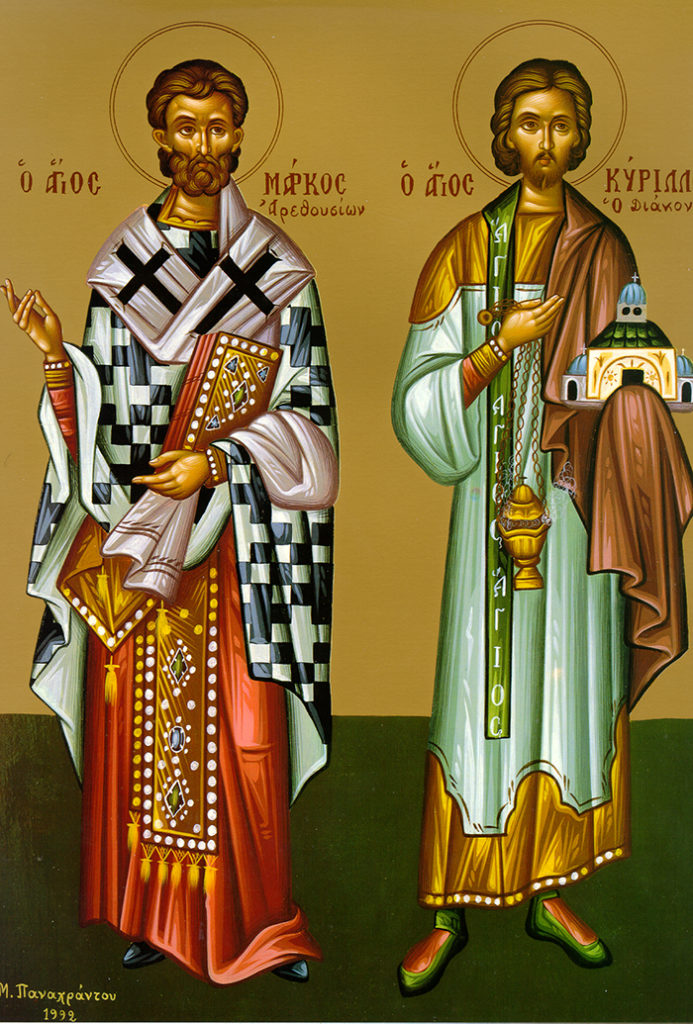
Our venerable hieromartyr Mark, Bishop of Arethusa, suffered for his faith in Christ under the emperor Julian the Apostate (361-363). By order of the emperor Constantine, St. Mark had once destroyed a pagan temple and built a Christian church. When Julian came to the throne, he persecuted Christians and tried to restore paganism. Some citizens of Arethusa renounced Christianity and became pagans. Then, St. Mark’s enemies decided to take revenge on him. The old bishop hid himself from the persecutors at first, but then he gave himself up when he learned that the pagans had tortured many people in their search for him. St. Gregory the Theologian describes the sufferings of St. Mark in his First Oration against Julian.
The historian Theodoritus relates that during the reign of St. Constantine the Great, St. Cyril destroyed many idols and pagan temples in Heliopolis, Phoenicia. He was put to death for this during the reign of Julian the Apostate. During this time the pagans killed many Christians in the Palestinian cities of Ascalon, and Gaza: priests, women and children who had dedicated themselves to God. The holy martyrs received crowns of victory in the Kingdom of Heaven, and the torturers also received their just recompense: eternal torment in Hell.
O God of our ancestors, You always deal with us according to your everlasting compassion, take not your mercy away from us; but through the prayers of our ancestors, guide our lives along the ways of peace.
Having become a splendor of truth, you have illumined the very ends of the earth. For this reason, we bless you, O martyred priests.
Philippians 4: 4-9
Brothers and sisters: Rejoice in the Lord always! I say it again. Rejoice! Everyone should see how unselfish you are. The Lord is near. Dismiss all anxiety from your minds. Present your needs to God in every form of prayer and in petitions full of gratitude. Then God’s own peace, which is beyond all understanding, will stand guard over your hearts and minds, in Christ Jesus.
Finally, my brothers and sisters, your thoughts should be wholly directed to all that is true, all that deserves respect, all that is honest, pure, admirable, decent, virtuous, or worthy of praise. Live according to what you have learned and accepted, what you have heard me say and seen me do. Then will the God of peace be with you.
John 12: 1-18
Six days before Passover Jesus came to Bethany, the village of Lazarus whom he had raised from the dead. There they gave him a banquet, at which Martha served. Lazarus was one of those at table with Jesus. Mary brought a pound of costly perfume made from genuine aromatic nard. With which she anointed the feet of Jesus. Then she dried his feet with her hair and the house was filled with the ointment’s fragrance. Judas Iscariot, one of his disciples (the one about to hand him over), protested: “Why was not this perfume sold? It could have brought three hundred silver pieces, and the money have been given to the poor.” (He did not say this out of concern for the poor, but because he was a thief. He held the purse, and used to help himself to what was deposited there.) To this Jesus replied: “Leave her alone. Let her keep it against the day they prepare me for burial. The poor you always have with you, but me you will not always have.”
The great crowd of Jews discovered Jesus was there and came out, not only because of Jesus but also to see Lazarus, whom Jesus had raised from the dead. The fact was, the chief priests planned to kill Lazarus too, because too many Jews were going over to Jesus and believing in him on account of Lazarus.
The next day the great crowd that had come for the feast heard that Jesus was to enter Jerusalem, so they got palm branches and came out to meet him. They kept shouting: “Hosanna! Blessed is he who comes in the name of the Lord! Blessed is the King of Israel!” Jesus found a donkey and mounted it, in accordance with Scripture: “Fear not, O daughter of Zion! Your king approaches you on a donkey’s colt.” (At first, the disciples did not understand all this, but after Jesus was glorified they recalled that the people had done to him precisely what had been written about him.)
The crowd that was present when Jesus called Lazarus out of the tomb and raised him from the dead kept testifying to it. The crowd came out to meet him because they heard he had performed this sign.
Icon courtesy of Jack Figel, Eastern Christian Publications – ecpubs.com
Saturday, March 28 –