
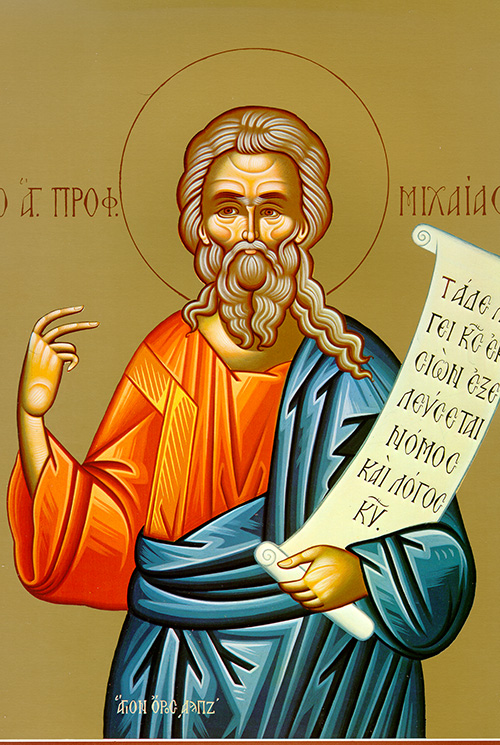
The holy prophet Micah was of the tribe of Judah and from the village of Morasth. He was a contemporary of the prophets Isaiah, Amos, and Hosea. He denounced the vices of the people, foretold the fall of Samaria, and was a seer of the coming Messiah. He named Bethlehem as the birthplace of the Messiah. He was buried in his own village, and his relics were found in the 4th century.
St. Theodosius of the Caves was the Father of monasticism in Russia. At the age of twenty-four, he secretly left his parental home and St. Anthony at the Kiev Caves monastery blessed him to receive monastic tonsure with the name Theodosius. The saint was not afraid to denounce the mighty of this world. Those unjustly condemned always found a defender in him, and judges would review matters at the request of the igumen. He was particularly concerned for the destitute. He built a special courtyard for them at the monastery where anyone in need could receive food and drink. Sensing the approach of death, St. Theodosius peacefully fell asleep in the Lord in the year 1074. He was buried in a cave which he dug, where he secluded himself during fasting periods. The relics of the ascetic were found incorrupt in the year 1091. St. Theodosius was numbered among the saints in 1108.
As we celebrate the memory of your prophet Micah, O Lord, we implore You to save our souls through his prayers.
Guide to Orthodoxy, teacher of piety and holiness, luminary for the world, inspired adornments of monks, O wise Theodosius, Harp of the Spirit, you enlightened all by your teachings; intercede with Christ our God to save our souls.
Celebrating your glorious memory today, the world mystically dances for joy and cries out to you, O Theotokos: Rejoice, Virgin, Boast of Christians.
You were enlightened by the blessing of the Holy Spirit, setting forth in prophecy the pure and immaculate condescension of Christ our God, O blessed Micah, and messenger of Christ. Therefore, pray for us who worthily honor your memory.
You are a successor to the fathers, O holy monk, and you followed them in your life and teachings, your character and temperance, prayer and intercession. Since you have found favor with God, obtain the remission of our sins and salvation for those who sing to you: Rejoice, O father Theodosius.
2 Corinthians 7: 10-16
Brothers and sisters: Indeed, sorrow for God’s sake produces a repentance without regrets, leading to salvation, whereas worldly sorrow brings death. Just look at the fruit of this sorrow which stems from God. What a measure of holy zeal it has brought you, not to speak of readiness to defend yourselves! What indignation, fear, and longing! What ardent desire to restore the balance of justice! In every way you have displayed your innocence in this matter. Therefore, my writing to you was not intended for the man who had given the offense or for the one offended, but to make plain in the sight of God the devotion you have for us. This done, we are comforted.
Beyond this consolation, we have rejoiced even more at the joy of Titus because his mind has been set at rest by all of you. For though I had boasted to him about you, I was not put to shame. Rather, just as everything I ever said to you was true, so my boasting to Titus has been proved equally true. His heart embraces you with an expanding love as he recalls the obedience you showed to God when you received him in fear and trembling. I rejoice because I trust you utterly.
Mark 2: 18-22
At that time John’s disciples and the Pharisees were accustomed to fast. People came to Jesus with the objection, “Why do John’s disciples and those of the Pharisees fast while yours do not?” Jesus replied: “How can the guests at a wedding fast as long as the groom is still among them? So long as the groom stays with them, they cannot fast. The day will come, however, when the groom will be taken away from them; on that day they will fast. No one sews a patch of shrunken cloth on an old cloak. If he should do so, the very thing he has used to cover the hole would pull away – the new from the old – and the tear would get worse. Similarly, no man pours new wine into old wineskins. If he does so, the wine will burst the skins, and both wine and skins will be lost. No, new wine is poured into new skins.”
Icon courtesy of Jack Figel, Eastern Christian Publications – ecpubs.com
Thursday, August 13 –