
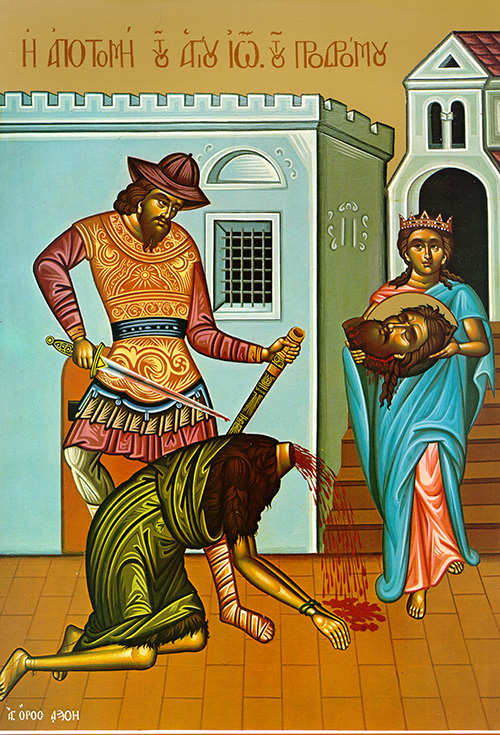
Beheading of the Holy Prophet, Forerunner, and Baptist John: Because the holy forerunner and baptist John had denounced Herod Antipas for putting away his own wife and marrying the wife of his brother Philip, Herod imprisoned him. At a feast held in honor of Herod’s birthday, Herod’s stepdaughter Salome danced for him. Herod promised her anything; her mother Herodias told her to ask for the head of John on a platter. This martyrdom is commemorated on this day because a church, built over the Forerunner’s tomb, was dedicated on this day to his beheading by the Emperor Constantine and his mother Helena.
The memory of the righteous is celebrated with praise, but for you, O Forerunner, the Lord’s testimony is enough. You were shown to be more honorable than the prophets since you were deemed worthy to baptize in the waters the Lord you had proclaimed. Therefore, you fought for the truth, and with joy proclaimed the good news to those in Hades, that God has appeared in the flesh to take away the sins of the world and to grant us great mercy.
The glorious beheading of the Forerunner was part of God’s saving plan that the coming of the Savior might be announced even to those in Hades. Let Herodias mourn for she sought a lawless murder because she loved neither the Law of God nor eternal life, but only this false and fleeting life.
Acts 13: 25-33
In those days Paul spoke to the Israelites saying: “As John’s career was coming to an end, he would say, ‘What you suppose me to be, I am not. Rather, look for the one who comes after me. I am not worthy to unfasten the sandals on his feet.’ My brethren, children of the family of Abraham and you others who reverence our God, it was to us that this message of salvation was sent forth. The inhabitants of Jerusalem and their rulers failed to recognize [Jesus], and in condemning him they fulfilled the words of the prophets which we read sabbath after sabbath. Even though they found no charge against him which deserved death, they begged Pilate to have him executed. Once they had thus brought about all that had been written of him, they took him down from the tree and laid him in a tomb. Yet God raised him from the dead, and for many days thereafter Jesus appeared to those who had come up with him from Galilee to Jerusalem. These are his witnesses now before the people.
“We ourselves announce to you the good news that what God promised our fathers he has fulfilled for us, their children in raising up Jesus, according to what is written in the second psalm, ‘You are my son; this day I have begotten you.’”
Mark 6: 14-29
At that time King Herod came to hear of Jesus, for his reputation had become widespread and people were saying, “John the Baptizer has been raised from the dead; that is why such miraculous powers are at work in him.” Others were saying, “He is Elijah”; still others, “He is a prophet equal to any of the prophets.” On hearing of Jesus, Herod exclaimed, “John, whose head I had cut off, has been raised up!” Herod was the one who had ordered John arrested, chained, and imprisoned on account of Herodias, the wife of his brother Philip, who he had married. That was because John had told Herod, “It is not right for you to live with your brother’s wife.” Herodias harbored a grudge against John for this and wanted to kill him but was unable to do so. Herod feared John, knowing him to be an upright and holy man, and kept him in custody. When he heard John speak he was very much disturbed; yet he felt the attraction of his words. Herodias had her chance one day when Herod held a birthday dinner for his court circle, military officers, and the leading men of Galilee. Herodias’ own daughter came in at one point and performed a dance which delighted Herod and his guests. The king told the girl, “Ask for anything you want and I will give it to you.” He went so far as to swear to her: “I will grant you whatever you ask, even half my kingdom!” She went out and said to her mother, “What should I ask for?” The mother answered, “The head of John the Baptizer.” At that the girl hurried back to the king’s presence and made her request: “I want you to give me, at once, the head of John the Baptizer on a platter.” The king bitterly regretted the request; yet because of his oath and the presence of the guests, he did not want to refuse her. He promptly dispatched an executioner, ordering him to bring back the Baptizer’s head. The man went and beheaded John in prison. He brought in the head on a platter and gave it to the girl, and the girl gave it to her mother. Later, when his disciples heard about this, they came and carried his body away and placed it in a tomb.
1 Corinthians 4: 1-5
Brothers and sisters: Men should regard us as servants of Christ and administrators of the mysteries of God. The first requirement of an administrator is that he prove trustworthy. It matters little to me whether you or any human court pass judgment on me. I do not even pass judgment on myself. Mind you, I have nothing on my conscience. But that does not mean that I am declaring myself innocent. The Lord is the one to judge me, so stop passing judgment before the time of his return. He will bring to light what is hidden in darkness and manifest the inventions of hearts. At that time, everyone will receive his praise from God.
Matthew 23: 1-12
At that time Jesus told the crowds and his disciples: “The scribes and the Pharisees have succeeded Moses as teachers; therefore, do everything and observe everything they tell you. But do not follow their example. Their words are bold but their deeds are few. They bind up heavy loads, hard to carry, to lay on other men’s shoulders while they themselves will not lift a finger to budge them. All their works are performed to be seen. They widen their phylacteries and wear huge tassels. They are fond of places of honor at banquets and the front seats in synagogues, of marks of respect in public and of being called ‘Rabbi.’ As to you, avoid the title ‘Rabbi.’ One among you is your teacher, the rest are learners. Do not call anyone on earth your father. Only one is your father, the One in heaven. Avoid being called teachers. Only one is your teacher, the Messiah. The greatest among you will be the one who serves the rest. Whoever exalts himself shall be humbled, but whoever humbles himself shall be exalted.”
Icon courtesy of Jack Figel, Eastern Christian Publications – ecpubs.com
Friday, August 28 –