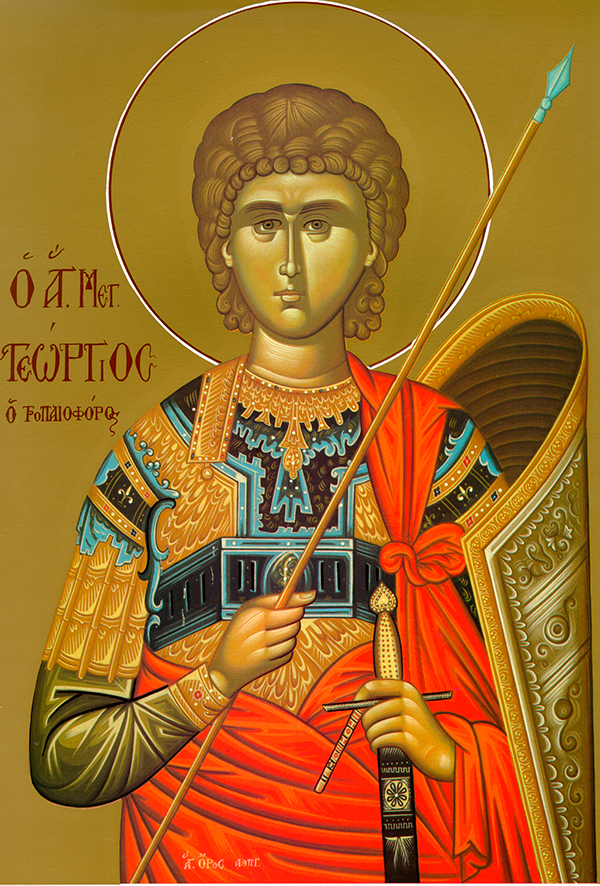
The holy great martyr George the Victory-bearer was a native of Cappadocia (a district in Asia Minor), and he grew up in a deeply believing Christian family. When he became a man, St. George entered into the service of the Roman army. He was handsome, brave and valiant in battle, and came to be noticed by the emperor Diocletian (284-305) and joined the imperial guard with the rank of comites, or military commander. Following the advice of the Senate at Nicodemedia, Diocletian gave all his governors full freedom in their court proceedings against Christians, and he promised them his full support. St. George, when he heard the decision of the emperor, distributed all his wealth to the poor, freed his servants, and then appeared in the Senate. The brave soldier of Christ spoke out openly against the emperor’s designs. He confessed himself a Christian, and appealed to all to acknowledge Christ: “I am a servant of Christ, my God, and trusting Him, I have come among you voluntarily, to bear witness concerning the Truth.” After many tortures and miraculous reprieves, St. George was finally beheaded after revealing the Truth of Christ to many, including the Empress Alexandra, who was martyred with him in the year 303.
You fought the good fight with faith, O George, a martyr of Christ. You exposed the perversion of the persecutors and offered an acceptable sacrifice to God. Therefore, you also received a crown of victory and through your prayers, O holy one, obtained the forgiveness of sins for all.
Reared by God, you were a noble sower of piety, harvesting sheaves of virtue. You sowed in tears but reaped in joy; and having honorably fought and given your blood, you were received by Christ. Through your prayers, O holy one, obtain the forgiveness of sins for all.
Acts 12: 1-11
In those days King Herod started to harass some of the members of the church. He beheaded James the brother of John, and when he saw that this pleased certain Jews, he took Peter into custody too. During the Feast of Unleavened Bread he had Peter arrested and thrown into prison with four squads of soldiers to guard him. Herod intended to bring him before the people after the Passover. Peter was thus detained in prison, while the church prayed fervently to God on his behalf. During the night before Herod was to bring him to trial, Peter was sleeping between two soldiers, fastened in double chains, while guards kept watch at the door. Suddenly an angel of the Lord stood nearby and light shone in the cell. He tapped Peter on the side and woke him. “Hurry, get up!” the angel said. With that, the chains dropped from Peter’s wrists. The angel said, “Put on your belt and your sandals!” This Peter did. Then the angel told him, “Now put on your cloak and follow me.”
Peter followed the angel out, but with no clear realization that this was taking place through the angel’s help. The whole thing seemed to him a mirage. They passed the first guard, then the second, and finally came to the iron gate leading out to the city, which opened for them of itself. They emerged and made their way down a narrow alley, when suddenly the angel left him. Peter had recovered his senses by this time, and said, “Now I know for certain that the Lord has sent his angel to rescue me from Herod’s clutches and from all the Jews hoped for.”
John 15: 17-27, 16: 1-2
The Lord said to his disciples: “The command I give you is this, that you love one another. If you find that the world hates you, know that it has hated me before you. If you belonged to the world, it would love you as its own; the reason it hates you is that you do not belong to the world. But I chose you out of the world. Remember what I told you: no slave is greater than his master. They will harry you as they harried me. They will respect your words as much as they respected mine. All this they will do to you because of my name, for they know nothing of him who sent me. If I had not come to them and spoken to them, they would no be guilty of sin; now, however, their sin cannot be excused.
“To hate me is to hate my Father. Had I not performed such works among them as no one has ever done before, they would not be guilty of sin; but as it is, they have seen, and they go on hating me and my Father. However, this only fulfills the text of their law: ‘They hated me without cause.’ When the Paraclete comes, the Spirit of truth who comes from the Father – and whom I myself will send from the Father– he will bear witness on my behalf. You must bear witness as well, for you have been with me from the beginning.
“I have told all this to keep your faith from being shaken. Not only will they expel you from synagogues; a time will come when anyone who puts you to death will claim to be serving God!”
Acts 8: 26-39
In those days, an angel of the Lord then addressed himself to Philip: “Head south toward the road which goes from Jerusalem to Gaza, the desert route.” Philip began the journey. It happened that an Ethiopian eunuch, a court official in charge of the entire treasury of Candace (a name meaning Queen) of the Ethiopians, had come on a pilgrimage to Jerusalem and was returning home. He was sitting in his carriage reading the prophet Isaiah. The Spirit said to Philip, “Go and catch up with that carriage.” Philip ran ahead and heard the man reading the prophet Isaiah. He said to the eunuch, “ Do you really grasp what you are reading?” “How can I,” the man replied, “unless someone explains it to me?” With that, he invited Philip to get in and sit down beside him. This was the passage of Scripture he was reading: “Like a sheep he was led to the slaughter, like a lamb before its shearer he was silent and opened not his mouth. In his humiliation he was deprived of justice. Who will ever speak of his posterity, for he is deprived of justice. Who will ever speak of his posterity, for he is deprived of his life on earth?” The eunuch said to Philip, “Tell me, if you will, of whom the prophet says this himself or someone else?” Philip launched out with this Scripture passage as his starting point, telling him the good news of Jesus. As they moved along the road they came to some water, and the eunuch said, “Look, there is some water right there. What is keeping me from being baptized?” He ordered the carriage stopped, and Philip went down into the water with the eunuch and baptized him. When they came out of the water, the Spirit of the Lord snatched Philip away and the eunuch saw him no more. Nevertheless the man went on his way rejoicing.
John 6: 40-44
The Lord said to the people coming to him: “Indeed, this is the will of my Father, but everyone who looks upon the Son and believes in him shall have eternal life. Him I will raise up on the last day.”
At this point the people started to murmur in protest because he claimed, “I am the bread that came down from heaven.” They kept saying: “ Is this not Jesus, the son of Joseph? Do we not know his father and mother? How can I claim to have come down from heaven?”
“Stop your murmuring,” Jesus told them. “No one can come to me unless the Father who sent me draws him; I will raise him up on the last day.
Icon courtesy of Jack Figel, Eastern Christian Publications – ecpubs.com
Wednesday, April 22 –