
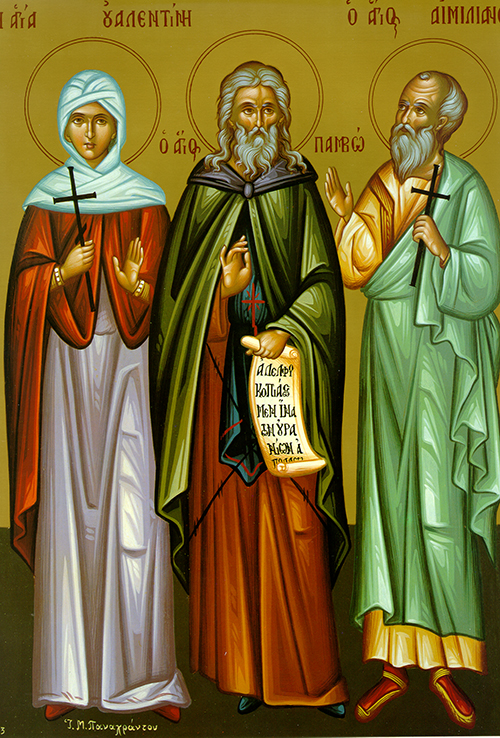
The holy martyr Hyacinth was born into a pious Christian family in the city of Amastridea (now Amastra in Anatolia). An angel that appeared gave him his name. As a three-year-old boy, St. Hyacinth asked God that a dead infant might be resurrected. The Lord hearkened to his childish prayer, and the dead one arose. Both lads afterwards grew up together, and they lived an ascetic life. St. Hyacinth once noticed how the pagans were worshiping a tree, and so he chopped it down. For this they subjected him to harsh tortures. They smashed out all his teeth, and having bound him with rope, they dragged him along the ground and threw him in prison. It was there that the holy sufferer departed to the Lord.
The holy martyr Emilian, who was a Slav, suffered for Christ during the reign of Emperor Julian the Apostate (361-363). Julian wanted to restore the cult of the pagan gods throughout the Roman Empire, and he issued an edict, according to which all Christians who failed to honor the pagan gods would be subject to death. Instead of being intimidated by these threats, St. Emilian’s faith in Christ was strengthened. The next day he went into a pagan temple and smashed the statues with a hammer. The governor ordered that St. Emilian be beaten mercilessly, and then to be burned alive. He did not perish when he was thrown into the fire, but instead the flames consumed many of the pagans who were standing about. When the fire had gone out, St. Emilian lay down upon the dying embers, and gave up his soul to the Lord. The wife of the pagan ruler was also a secret Christian, and she gathered up the saint’s relics and buried them. Afterward, a church dedicated to the holy Martyr Emilian was built at Constantinople, where his relics were transferred.
The venerable martyr Tarsykia Matskiv was a nun in the order of the Congregation of the Sisters Servants of Mary Immaculate. During the Second World War she was missioned in the Ukrainian city of Krystynopil. When the Soviet Army invaded the city in 1944, Sister Tarsykia was shot by a soviet soldier as she went to open the gates to welcome the priest coming to celebrate Divine Liturgy. She was buried in the garden of the convent under the statue of the Theotokos, as it was too dangerous to go to the cemetery. On September 2, 2007, Blessed Tarsykia’s mortal remains were exhumed, and ceremonially transferred to her hometown of Chodoriv, via the Cathedral of Stryj Eparchy. In silent procession, throngs of people escorted her relics, borne on the shoulders of priests, as pallbearers, to an outdoor Divine Liturgy, to accommodate these crowds, before being encrypted in the church itself. This was the funeral Blessed Tarsykia never had.
O Lord our God, your holy martyrs have deserved the crown of immortality on account of their good fight. Armed with your strength, they have vanquished their persecutors and crushed Satan’s dreadful might. Through their supplications, O Christ our God, save our souls.
Inflamed with the divine fervor, you were not afraid of the fire. You entered it willingly and were reduced to ashes in the flames. You went up like a sacrifice to the Master. O glorious martyr Emilian, pray for us.
Romans 13: 1-10
Brothers and sisters: Let everyone obey the authorities that are over him, for there is no authority except from God, and all authority that exists is established by God. As a consequence, the man who opposes authority rebels against the ordinance of God; those who resist thus shall draw condemnation down upon themselves. Rulers cause no fear when a man does what is right but only when his conduct is evil. Do you wish to be free from the fear of authority? Do what is right and you will gain its approval, for the ruler is God’s servant to work for your good. Only if you do wrong ought you to be afraid. It is not without purpose that the ruler carries the sword; he is God’s servant, to inflict his avenging wrath upon the wrongdoer. You must obey, then, not only to escape punishment but also for conscience’ sake. You pay taxes for the same reason, magistrates being God’s ministers who devote themselves to his service with unremitting care. Pay each one his due: taxes to whom taxes are due; toll to whom toll is due; respect and honor everyone who deserves them.
Owe no debt to anyone except the debt that binds us to love one another. He who loves his neighbor has fulfilled the law. The commandments, “You shall not commit adultery; you shall not murder; you shall not steal; you shall not covet,” and any other commandment there may be are all summed up in this, “You shall love your neighbor as yourself.” Lover never wrongs the neighbor, hence love is the fulfillment of the law.
Matthew 12: 30-37
The Lord said: “He who is not with me is against me, and he who does not gather with me scatters. That, I assure you, is why every sin, every blasphemy, will be forgiven men, but blasphemy against the Spirit will not be forgiven. Whoever says anything against the Son of Man will be forgiven, but whoever says anything against the Holy Spirit will not be forgiven, either in this age or in the age to come. Declare a tree good and its fruit good or declare a tree rotten and its fruit rotten, one or the other, for you can tell a tree by its fruit. How can you utter anything good, you brood of vipers, when you are so evil? The mouth speaks whatever fills the mind. A good man produces good from his store of goodness; an evil man produces evil from his evil store. I assure you, on judgment day people will be held accountable for every unguarded word they speak. By your words you will be acquitted, and by your words you will be condemned.”
Icon courtesy of Jack Figel, Eastern Christian Publications – ecpubs.com
Friday, July 17 –