
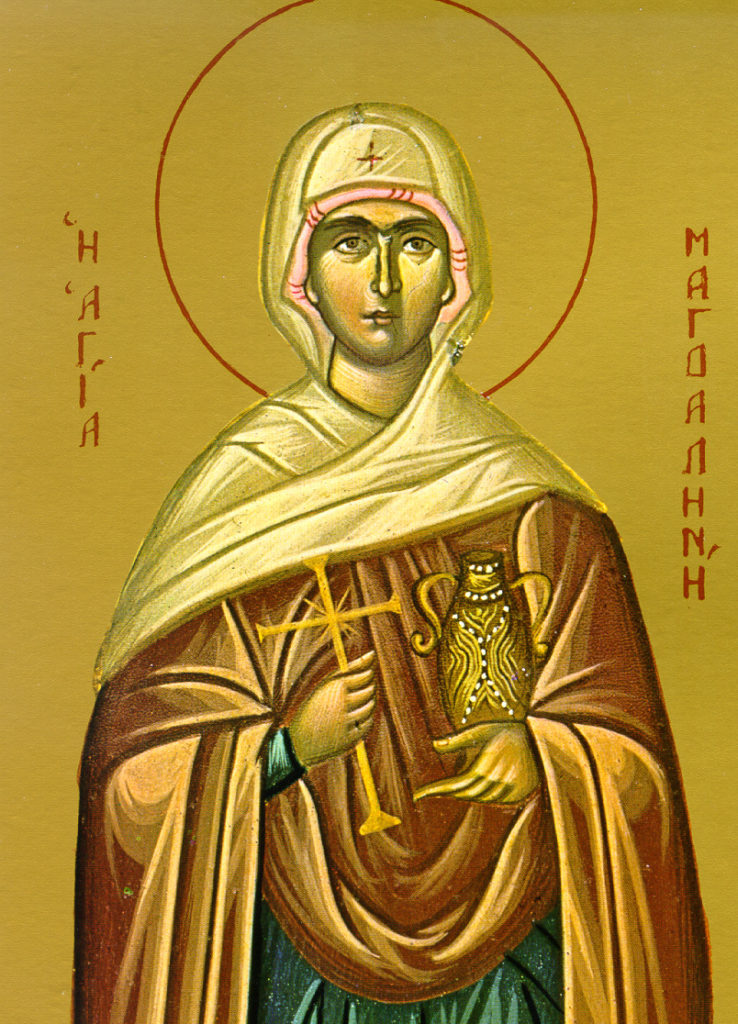
The holy myrrh-bearer Mary Magdalene, equal to the apostles, who, freed by the Lord of seven demons and made a disciple, followed him even to Mount Calvary. At the break of dawn on the first Pascha, she was found worthy to see the Savior risen again from the dead and to bear the news of his resurrection to the other disciples.
The holy bishop-martyr Phocas was bishop of Sinope (a city on the Black Sea). His relics were taken from Sinope to Vienne in France in the 13th century, and today is the feast of the translation.
You followed Christ who was born of a virgin for us, keeping his laws and observing his decrees, O Mary. In return we observe your holy memory that our sins might be forgiven through your prayers.
O holy priest-martyr Phocas, you lent yourself to the apostles’ way of life and succeeded them on their throne. Inspired by God, you found the way to contemplation through the practice of virtue. Therefore, you became a perfect teacher of truth, fighting for the faith unto the shedding of your blood. Intercede with Christ our God that He may save our souls.
You stood before the cross with the others, O glorious Mary, and you cried as you suffered there with the Theotokos. You opened your mouth in praise, saying: How strange this is that He who upholds all creation has deigned to suffer. Glory to your power!
As a pastor who offered sacrifice, you bore witness to Christ with justice. Strengthened by angels, you yearned for death. At last you offered yourself as a sacrifice to Him who abides among those who sing to you. Stay with us, O father, and never leave us.
1 Corinthians 9: 2b-12
Although I may not be an apostle for others, certainly I am for you, for you are the seal of my apostleship in the Lord.
My defense against those who would pass judgment on me is this. Do we not have the right to eat and drink? Do we not have the right to take along a Christian wife, as do the rest of the apostles, and the brothers of the Lord, and Cephas? Or is it only myself and Barnabas who do not have the right not to work? Who ever serves as a soldier at his own expense? Who plants a vineyard without eating its produce? Or who shepherds a flock without using some of the milk from the flock? Am I saying this on human authority, or does not the law also speak of these things? It is written in the law of Moses, “You shall not muzzle an ox while it is treading out the grain.” Is God concerned about oxen, or is he not really speaking for our sake? It was written for our sake, because the plowman should plow in hope, and the thresher in hope of receiving a share. If we have sown spiritual seed for you, is it a great thing that we reap a material harvest from you? If others share this rightful claim on you, do not we still more?
John 20: 11-18
But Mary stayed outside the tomb weeping. And as she wept, she bent over into the tomb and saw two angels in white sitting there, one at the head and one at the feet where the body of Jesus had been. And they said to her, “Woman, why are you weeping?” She said to them, “They have taken my Lord, and I don’t know where they laid him.” When she had said this, she turned around and saw Jesus there, but did not know it was Jesus. Jesus said to her, “Woman, why are you weeping? Whom are you looking for?” She thought it was the gardener and said to him, “Sir, if you carried him away, tell me where you laid him, and I will take him.” Jesus said to her, “Mary!” She turned and said to him in Hebrew, “Rabbouni,” which means Teacher. Jesus said to her, “Stop holding on to me, for I have not yet ascended to the Father. But go to my brothers and tell them, ‘I am going to my Father and your Father, to my God and your God.’” Mary of Magdala went and announced to the disciples, “I have seen the Lord,” and what he told her.
1 Corinthians 13:4 – 14:5
Brothers and sisters: Love is patient; love is kind. Love is not jealous, it does not put on airs, it is not snobbish. Love is never rude, it is not self-seeking, it is not prone to anger; neither does it brood over injuries. Love does not rejoice in what is wrong but rejoices with the truth. There is no limit to love’s forbearance, to its trust, its hope, its power to endure.
Love never fails. Prophecies will cease, tongues will be Silent, knowledge will pass away. Our knowledge is imperfect and our prophesying is imperfect. When the perfect comes, the imperfect will pass away. When I was a child I used to talk like a child, think like a child, reason like a child. When I became a man I put childish ways aside. Now we see indistinctly, as in a mirror; then we shall see face to face. My knowledge is imperfect now; then I shall know even as I am known. There are in the end three things that last: faith, hope, and love, and the greatest of these is love.
Seek eagerly after love. Set your hearts on spiritual gifts – above all, the gift of prophecy. A man who speaks in a tongue is talking not to men but to God. No one understands him, because he utters mysteries on the Spirit. The prophet, on the other hand, speaks to men for their up-building, their encouragement, their consolation. He who speaks in a tongue builds up himself, but he who prophesies builds up the church. I should like it if all of you spoke in tongues, but I much prefer that you prophesy. The prophet is greater than one who speaks in tongues, unless the speaker can also interpret for the upbuilding of the church.
Matthew 20: 1-16
The Lord told this parable: “The reign of God is like the case of the owner of an estate who went out at dawn to hire workmen for his vineyard. After reaching an agreement with them for the usual daily wage, he sent them out to his vineyard. He came out about midmorning and saw other men standing around the marketplace without work, so he said to them, ‘You too go along to my vineyard and I will pay you whatever is fair.’ At that they went away. He came out again around noon and midafternoon and did the same. Finally, going out in the late afternoon he found still others standing around. To these he said, ‘Why have you been standing here idle all day?’ ‘No one hired us,’ they told him. He said, ‘You go to the vineyard too.’
“When evening came the owner of the vineyard said to his foreman, ‘Call the workmen and give them their pay, but begin with the last group first.’ When those hired late in the afternoon came up they received a full day’s pay, and when the first group appeared they supposed they would get more; yet they received the same daily wage. ‘This last group did only an hour’s work, but you have put them on the same basis as us who have worked a full day in the scorching heat.’ ‘My friend,’ he said to one in reply, ‘I do you no injustice. You agreed on the usual wage, did you not? Take your pay and go home. I intend to give this man who was hired last the same pay as you. I am free to do as I please with my money, am I not? Or are you envious because I am generous?’ Thus the last shall be first and the first shall be last.”
Icon courtesy of Jack Figel, Eastern Christian Publications – ecpubs.com
Tuesday, July 21 –