
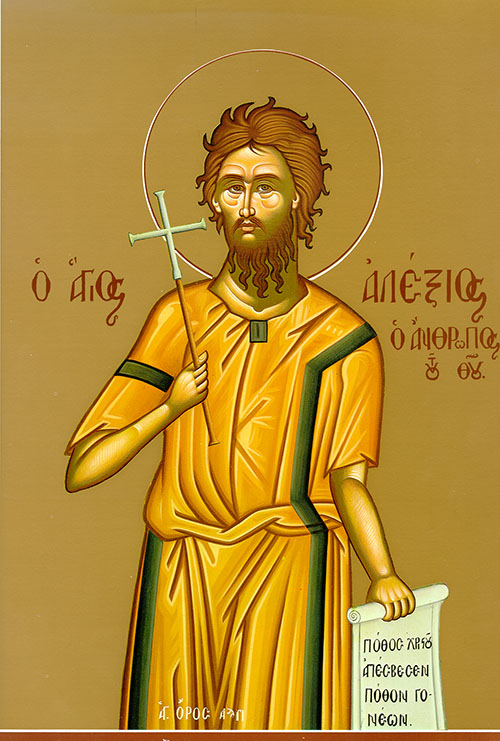
Our venerable father Alexis was born in Rome to the pious and poverty-loving parents Euphemianus and Aglais. The couple was childless for a long time and they constantly prayed to the Lord to grant them a child, so the Lord consoled them with the birth of their son Alexis. After he moved to Edessa, Alexis sold everything he had, distributed the money to the poor, and began to live near the church of the Most Holy Theotokos under a portico. The saint used a portion of the alms he received to buy bread and water, and he distributed the rest to the aged and infirm. St. Alexis dwelt in Edessa for seventeen years. He secretly boarded a ship bound for Cilicia, intending to visit the church of St. Paul in Tarsus, but God ordained otherwise. A storm took the ship far to the west and it reached the coast of Italy. He journeyed to Rome and decided to live in his own house. Unrecognized, he humbly asked his father’s permission to settle in some corner of his courtyard. Euphemianus settled Alexis in a specially constructed cell and gave orders to feed him from his table. St. Alexis dwelt at the house of his parents for seventeen years and the Lord revealed to him the day of his death. Then the saint, taking paper and ink, wrote certain things that only his wife and parents would know. He also asked them to forgive him for the pain he had caused them.
Rich in poverty and clean of heart by virtue, you adorned your life by partaking in the passion. With a clean conscience you took up fasting and persevered in prayer like an angel. You glowed like the sun on the world, O most blessed Alexis.
You made your parents’ home that of a stranger, and you lived in its shelter as a beggar. When you passed from this life you were crowned in glory, and your reputation has become magnificent on earth. Rejoice, O Alexis, man of God and joy of angels.
After these things the word of the Lord came to Abram in a vision, “Do not be afraid, Abram, I am your shield; your reward shall be very great.” But Abram said, “O Lord God, what will you give me, for I continue childless, and the heir of my house is Eliezer of Damascus?” And Abram said, “You have given me no offspring, and so a slave born in my house is to be my heir.” 4 But the word of the Lord came to him, “This man shall not be your heir; no one but your very own issue shall be your heir.” He brought him outside and said, “Look toward heaven and count the stars, if you are able to count them.” Then he said to him, “So shall your descendants be.” And he believed the Lord; and the Lord reckoned it to him as righteousness.
Then he said to him, “I am the Lord who brought you from Ur of the Chaldeans, to give you this land to possess.” But he said, “O Lord God, how am I to know that I shall possess it?” He said to him, “Bring me a heifer three years old, a female goat three years old, a ram three years old, a turtledove, and a young pigeon.” He brought him all these and cut them in two, laying each half over against the other; but he did not cut the birds in two. And when birds of prey came down on the carcasses, Abram drove them away.
As the sun was going down, a deep sleep fell upon Abram, and a deep and terrifying darkness descended upon him. Then the Lord said to Abram, “Know this for certain, that your offspring shall be aliens in a land that is not theirs, and shall be slaves there, and they shall be oppressed for four hundred years; but I will bring judgment on the nation that they serve, and afterward they shall come out with great possessions. As for yourself, you shall go to your ancestors in peace; you shall be buried in a good old age.
The lips of the wise spread knowledge; not so the minds of fools.
The sacrifice of the wicked is an abomination to the Lord, but the prayer of the upright is his delight.
The way of the wicked is an abomination to the Lord, but he loves the one who pursues righteousness.
There is severe discipline for one who forsakes the way, but one who hates a rebuke will die.
Sheol and Abaddon lie open before the Lord, how much more human hearts!
Scoffers do not like to be rebuked; they will not go to the wise.
A glad heart makes a cheerful countenance, but by sorrow of heart the spirit is broken.
The mind of one who has understanding seeks knowledge, but the mouths of fools feed on folly.
All the days of the poor are hard, but a cheerful heart has a continual feast.
Better is a little with the fear of the Lord than great treasure and trouble with it.
Better is a dinner of vegetables where love is than a fatted ox and hatred with it.
Those who are hot-tempered stir up strife, but those who are slow to anger calm contention.
The way of the lazy is overgrown with thorns, but the path of the upright is a level high
Icon courtesy of Jack Figel, Eastern Christian Publications – ecpubs.com
Monday, March 16 –