
Our holy father Michael the Confessor was a monk in a monastery on the coast of the Black Sea before the Patriarch Tarasius (784-806) consecrated him as Bishop of the city of Synnada. He was present at the Seventh Ecumenical Council at Nicea in 787. St. Michael bravely and openly opposed the iconoclast heresy of Leo the Armenian (813-820), and was banished to the city of Eudokiada, where he died in the year 821.
Troparion
The sincerity of your deeds has revealed you to your people as a teacher of moderation, a model of faith, and an example of virtue. Therefore, you attained greatness through humility, and wealth through poverty. O father and archbishop Michael, ask Christ our God to save our souls.
Kontakion
As a dear prelate and a holy martyred priest, you did not fear the threats of the evil one. You fought heretical forces by proclaiming: I reverence the icon of Christ and that of his most pure Mother. For this we honor you, O Michael.
Epistle
Acts 15: 5-12
In those days, some of the converted Pharisees then got up and demanded that such Gentiles be circumcised and told to keep Mosaic law. The apostles and the presbyters accordingly convened to look into the matter. After much discussion, Peter took the floor and said to them: “Brothers, you know well enough that from the early days God selected me from your number to be the one whose lips the Gentile would hear the message of the gospel and believe. God, who reads the hearts of men, showed his approval by granting the Holy Spirit to them just as he did to us. He made no distinction between them and us, but purified their hearts by means of faith also. Why, then, do you put God to the test by trying to place on the shoulders of these converts a yoke which neither we nor our fathers were able to bear? Our belief is rather that we are saved by the favor of the Lord Jesus and so are they.” At that the whole assembly fell silent. They listened to Barnabas and Paul as the two described all the signs and wonders God had worked among the Gentiles through them.
Gospel
John 10: 17-28
The Lord said to the people coming to him: “The Father loves me for this: that I lay down my life to take it up again. No one takes it from me; I lay it down freely. I have power to lay it down, and I have power to take it up again. This command I received from my Father.”
Because of these words, the Jews were sharply divided once more. Many were claiming: “He is possessed by a devil – out of his mind! Why pay attention to him?” Others maintained: “These are not the words of a madman. Surely a devil cannot open the eyes of the blind!”
It was winter, and the time came for the feast of the Dedication in Jerusalem. Jesus was walking in the temple area, in Solomon’s Portico, when the Jews gathered around him and said, “How long are you going to keep us in suspense? If you really are the Messiah, tell us so in plain words.” Jesus answered: “I did tell you, but you do not believe. The works I do in my Father’s name give witness in my favor, but you refuse to believe because you are not my sheep. My sheep hear my voice. I know them, and they follow me. I give them eternal life, and they shall never perish.”
Icon courtesy of Jack Figel, Eastern Christian Publications – ecpubs.com
The holy martyr Basiliscus was a soldier and a cousin of St. Theodore the Recruit. Through his preaching and example, St. Basiliscus brought many to the Faith. He suffered greatly for the sake of Christ. His two brothers suffered with him and were crucified before he was sent to Prison in Comana where he met his martyrdom by beheading in the year 308.
Troparion
O Lord our God, your holy martyr Basiliscus has deserved the crown of immortality on account of his good fight. Armed with your strength, he has vanquished his persecutors and crushed Satan’s dreadful might. Through his supplications, O Christ our God, save our souls.
Kontakion
You stood firmly with fortitude in your sufferings. You astonish us with your wonderful miracles which promote the name of Christ among us. You shamed the devil and so we venerate you, calling out: Rejoice, O Basiliscus, dearest and most brilliant of martyrs.
Epistle
Acts 14:20b – 15:4
In those days, Paul left with Barnabas for Derbe. After they had proclaimed the good news in that town and made numerous disciples, they retracted their steps to Lystra and Iconium first, then to Antioch. They gave their disciples reassurances, and encouraged them to preserve in the faith with this instruction: “We must undergo many trials if we are to enter into the reign of God.” In each church they installed presbyters and, with prayer and fasting, commended them to the Lord in whom they had put their faith.
Then they passed through Pisidia and came to Pamphylia. After preaching the message in Perga, they went down to Attalia. From there they sailed back to Antioch, where they had first been commended to the favor of God for the task they had now completed. On their arrival, they called the congregation together and related all that God had helped them accomplish, and how he opened the door of faith to the Gentiles. Then they spent some time there with the disciples.
Some men came down to Antioch from Judea and began to teach the brothers, “Unless you are circumcised according to Mosaic practice, you cannot be saved.” This created dissension and much controversy between them and Paul and Barnabas. Finally it was decided that Paul, Barnabas, and some others should go up to see the apostles and presbyters in Jerusalem about this question.
The church saw them off and they made their way through Phoenicia and Samaria, telling everyone about the conversion of the Gentiles as they went. Their story caused great joy among the brothers. When they arrived in Jerusalem they were welcomed by that church, as well as by the apostles and the presbyters, to whom they reported all that God has helped them accomplish.
Gospel
John 9:39-41, 10:1-9
The Lord said to the people coming to him: “I came into this world to divide it, to make the sightless see and the seeing blind.” Some of the Pharisees around him picked this up, saying, “You are not calling us blind, are you?” To which Jesus replied: “If you were blind there would be no sin in that. ‘But we see,’ you say, and your sins remain. Truly I assure you: Whoever does not enter the sheepfold through the gate but climbs in some other way is a thief and a marauder. The one who enters through the gate is shepherd of the sheep; the keeper opens the gate for him. The sheep hear his voice as he calls his own by name and leads them out. When he has brought out those that are his, he walks in front of them, and the sheep follow him because they recognize his voice. They will not follow a stranger; such a one they will flee, because they do not recognize a stranger’s voice.”
Even though Jesus used this figure with them, they did not grasp what he was trying to tell them. He therefore said to them again: “My solemn word is this: I am the sheepgate. All who came before me were thieves and marauders whom the sheep did not heed. I am the gate. Whoever enters through me will be safe. He will go in and out, and find pasture.”
Icon courtesy of Jack Figel, Eastern Christian Publications – ecpubs.com
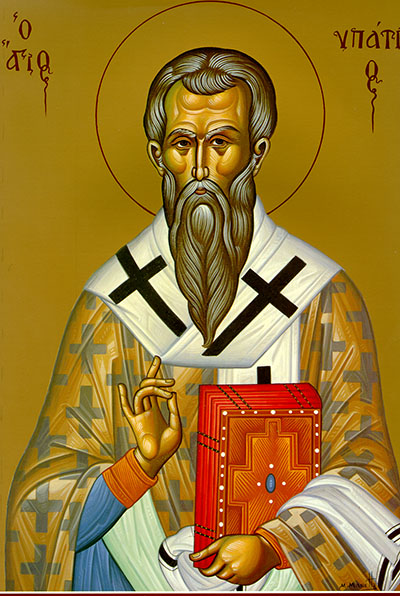
The holy Emperor Constantine reigned in ancient Rome and in Byzantium (which became New Rome), and was the first Christian emperor and champion of the Faith. Though he was not baptized until on his deathbed, he considered himself a Christian, and called the First Ecumenical Council at Nicea in 325 to settle the Arian heresy.
On the Via Labicana in old Rome, Helen, the mother of emperor Constantine, is remembered. She single-mindedly worked to help the needy and piously visited churches, mingling with the crowds. Having made a pilgrimage to Jerusalem to see the places of the Nativity, Passion, and Resurrection of Christ, she honored the manger and cross of the Lord by building basilicas worthy of respect.
Troparion
Seeing the cross in the sky like Paul, and like him you received a call from the Divine. You committed the royal city into the hands of the Lord. Save this city always in peace, O only Lover of Humankind, through the prayers of the Theotokos.
Kontakion
Today Constantine and his mother Helen reveal the cross, that most precious tree which puzzles the Jews. It is the armor of Christian authority against enemies. It has proved itself awesome in war by its many miracles.
Readings for the feast
Epistle
Acts 26: 1-5 & 12-20
In those days Agrippa spoke to Paul: “You have permission to state your case.” So Paul stretched out his hand and began his defense. “Many charges have been leveled against me by the Jews, King Agrippa. I count myself fortunate to be able to make my defense today in your presence, especially since you are expert in all the various Jewish customs and disputes. I beg you to listen to me patiently.
“The way I have lived since my youth, and the life I have led among my own people from the beginning and later at Jerusalem, is well known to all Jews. They have been acquainted with me for a long time and can testify if they wish, to my life lived as a Pharisee, the strictest sect of our religion.
“On one such occasion I was traveling toward Damascus armed with the authority and commission of the chief priests. On this journey, Your Majesty, I saw a light more brilliant than the sun shining in the sky at midday. It surrounded me and those who were traveling with me. All of us fell to the ground and I heard a voice saying to me in Hebrew, ‘Saul, Saul, why do you persecute me? It is hard for you to kick against the goad.’ I said, at that, ‘Who are you, sir?’ and the Lord answered: ‘I am that Jesus who you are persecuting. Get up now and stand on your feet. I have appeared to you to designate you as my servant and as a witness to what you have seen of me and what you will see of me.
‘I have delivered you from this people and from the nations, to open the eyes of those to whom I am sending you, to turn them from darkness to light and from the dominion of Satan to God; that through their faith in me they may obtain the forgiveness of their sins and a portion among God’s people.’
“King Agrippa, I could not disobey that heavenly vision. I preached a message of reform and of conversion to God, first to the people of Damascus, then to the people of Jerusalem and all the country of Judea; yes, even to the Gentiles. I urged them to act in conformity with their change of heart.”
Gospel
John 10: 1-9
The Lord said, “Truly I assure you: whoever does not enter the sheepfold through the gate but climbs in some other way is a thief and a marauder. The one who enters through the gate is shepherd of the sheep; the keeper opens the gate for him. The sheep hear his voice as he calls his own by name and leads them out. When he has brought out those that are his, he walks in front of them, and the sheep follow him because they recognize his voice. They will not follow a stranger; such a one they will flee, because they do not recognize a stranger’s voice.”
Even though Jesus used this figure with them, they did not grasp what he was trying to tell them. He therefore said to them again: “My solemn word is this: I am the sheepgate. All who came before me were thieves and marauders whom the sheep did not heed. I am the gate. Whoever enters through me will be safe. He will go in and out, and find pasture.”
Readings for the day
Epistle
Acts 13: 13-24
In those days, from Paphos, Paul and his companions put out to sea and sailed to Perga in Pamphylia. There John left them and returned to Jerusalem. They continued to travel on from Perga to Antioch in Pisidia. On the sabbath day they entered the synagogue and sat down. After the reading of the law and of the prophets, the leading men of the synagogue sent this message to them: “Brothers, if you have any exhortation to address to the people, please speak up.”
So Paul arose, motioned to them for silence, and began: “Fellow Israelites and you others who reverence our God, listen to what I have to say! The God of the people Israel once chose our fathers. He made this people great during their sojourn in the land of Egypt, and with an outstretched arm he led them out of it. For forty years he put up with them in the desert: then he destroyed seven nations in the land of Canaan to give them that country as their heritage at the end of some four hundred and fifty years. Later on he set up judges to rule them until the time of the prophet Samuel. When they asked for a king, God gave them Saul son of Kish, of the tribe of Benjamin, who ruled for forty years. Then God removed him and raised up David as their king; on this behalf God testified, ‘I have found David son of Jesse to be a man after my own heart who will fulfill my every wish.’
“According to his promise, God has brought forth from this man’s descendants Jesus, a savior for Israel. John heralded the coming of Jesus by proclaiming a baptism of repentance to all the people of Israel.”
Gospel
John 6: 5:14
At that time Jesus looked up and caught sight of a vast crowd coming toward him. He said to Philip, “Where shall we buy bread for all these people to eat?” He knew well what he intended to do but he asked this to test Philip’s response. Philip replied, “Not even with two hundred days’ wages could we buy loaves enough to give each of them a mouthful!”
One of Jesus/ disciples, Andrew, Simon Peter’s brother, remarked to Jesus, “There is a lad here who has five barley loaves and a couple of dried fish, but what good is that for so many?” Jesus said, “Get the people to recline.” Even though the men numbered about five thousand, there was plenty of grass for them to find a place on the ground. Jesus then took the loaves of bread, gave thanks, and passed them around to those reclining there; he did the same with the dried fish, as much as they wanted. When they had had enough, he told his disciples, “Gather up the crusts that are left over so that nothing will go to waste.” At this, they gathered twelve baskets full of pieces left over by those who had been fed with the five barley loaves. When the people saw the sign he had performed they began to say, “This undoubtedly the Prophet who is to come into the world.”
Icon courtesy of Jack Figel, Eastern Christian Publications – ecpubs.com
The Carlin Family, Michael Hefferon, Shirley Kunze, Michael Mina, Peter Mina, Fr. John Mina, Mila Mina, Lana Zimmerman, Patrick Zimmerman, Shannon O’Neill, Fern Bonowicz, Stephen Petach, Jenny Roman, All the sick and suffering of St. Mary’s
Saint Photina
The Church has given the woman in today’s Gospel passage the name “Photina”. Her name means “light” because she is both enlightened herself, and directs the whole town back to Christ who is the Light of Life.
What does it mean that she is enlightened? First, remember we are in the Paschal season, so the neophytes (newly baptized) called the “Newly Enlightened” are discovering the many fruits of what it means to have:
-died to the old self to live for Christ – Colossians 3:3
-put off the old man and put on the new – Ephesians 4:22
-been called to offer mercy, not fruitless sacrifice – Matthew 9:13/ Hosea 6:6
-guided to embrace a neediness before God, sorrow for injustice, humility, yearning for God’s Way, forgiveness, courage in God’s Will, and a willingness to be a beacon of Truth in a world that exalts power and control – Matthew 5
The Samaritan Woman, before encountering Christ, was living a life of discontent and shame. After Christ, she has rest, contentment, healing and confidence. When Christ enlightened her (Christ giving her “living Water” points to baptism) she has discovered the one relationship that will fulfill her neediness, knows how to interact with the Divine, and has the confidence to become fearless before evil. She is no longer deceived, but rather has found the Truth and is changing her life as a result.
She then enlightens the whole town by refusing to hoard the Gift she has received, but rather knows that that Gift is only amplified when it continues to be given, and so becomes a witness to the healing power of God.
“We have heard for ourselves and we know that this is indeed the Savior of the world, the Christ.” The saving love of Christ quenched the thirst of the Samaritan woman. He wants all to be saved and to come to the knowledge of the truth. Are you open to bringing that saving love to the world by becoming a priest, deacon, monk or nun? Contact the Vocations Office at 602-861-9778 or email: vocations@ephx.org
The holy martyr Thaleleus at Agea in Cilicia. Born in Lebanon in the third century, St. Thaleleus was an eighteen-year-old fair haired young man, training to be a physician. He courageously confessed Christ as God. After several attempts to execute the martyr, he was finally beheaded. The relics of the holy martyr Thallelaeus are in the church of St. Agathonicus of Constantinople and have performed many miracles. Because St. Thalelaeus treated the sick without payment, the Church calls him an Unmercenary Physician. He is invoked in prayers during the sacrament of the Anointing of the Sick, and during the Blessing of Waters.
Troparion
O Lord our God, your holy martyr Thaleleus has deserved the crown of immortality on account of his good fight. Armed with your strength, he has vanquished his persecutors and crushed Satan’s dreadful might. Through his supplications, O Christ our God, save our souls.
Kontakion
Becoming a companion of martyrs and a good warrior, you were a pleasing soldier to Christ, the King of glory. You wiped out the glory of idols by endurance and pain; therefore, O wise Thaleleus, we praise your memory.
Epistle
Acts 12:25 – 13:12
In those days, Barnabas, Symeon known as Niger, Lucius of Cyrene, Manaen (who had been brought up with Herod the tetrarch), and Saul. On one occasion, while they were engaged in the liturgy of the Lord and were fasting, the Holy Spirit spoke to them: “Set apart Barnabas and Saul for me to do the work for which I have called them.” Then, after they had fasted and prayed, they imposed hands on Paul and Barnabas and sent them off.
These two, sent forth by the Holy Spirit, went down to the port of Seleucia and set sail from there for Cyprus. On their arrival in Salamis they proclaimed the word of God in the Jewish synagogues, John accompanying them as an assistant. They traveled over the whole island as far as Paphos, where they came across a Jewish magician named Bar-Jesus who posed as a prophet. He was attached to the court of the proconsular governor Sergius Paulus, a man of intelligence who had summoned Barnabas and Saul and was anxious to hear the word of God. But Elymas – “the magician,” for that was what his name means – opposed them and sought to turn the governor away from the faith. Saul (also known as Paul) was filled with the Holy Spirit; he stared at Elymas and exclaimed: “You are an imposter and a thoroughgoing fraud, you son of Satan and enemy of all that is right! Will you never stop trying to make crooked the straight path of the Lord? The Lord’s hand is upon you even now! For a time you shall be blind, unable so much as to see the sun.” At once a musty darkness came over Elymas, and he groped about for someone to lead him by the hand. When the governor saw what had happened, he believed, so impressed was he by the teaching about the Lord.
Gospel
John 8:51-58
The Lord said to the people coming to him: “I solemnly assure you, if a man is true to my word he shall never see death.” The Jews retorted, “Now we are sure you are possessed. Abraham is dead. The prophets are dead. Yet you claim, ‘A man shall never know death if he keeps my word.’ Surely you do not pretend to be greater than our father Abraham, who died! Or the prophets, who died! Whom do you make yourself out to be?”
Jesus answered: “If I glorify myself, that glory comes to nothing. He who gives me glory is the Father, the very one you claim for your God, even though you so not know him. But I know him. Were I to say I do not know him, I would be no better than you – a liar! Yes, I know him well, and I keep his word. Your father Abraham rejoiced that he might see my day. He saw it and was glad.”
At this the Jews objected: “You are not yet fifty! How can you have seen Abraham?” Jesus answered them: “I solemnly declare it: before Abraham came to be, I AM.” At that they picked up rocks to throw at Jesus, but he hid himself and slipped out of the temple precincts.
Icon courtesy of Jack Figel, Eastern Christian Publications – ecpubs.com
The holy martyr Patrick, Bishop of Prusa, and his companions were martyred during the reign of the emperor Julian the Apostate. Taken to a boiling spring, the governor asked if Christ would save them. Patrick replied, “If he will, he can keep me whole and uninjured, although I would wish, in this water, to be parted from this temporal life that I may live eternally with Christ; but let his holy will be done, without which not a hair of a man’s head can fall.” He was thrown in the spring, but remained unharmed. He was then beheaded with his three presbyters.
Troparion
O holy priest-martyr Patrick, you lent yourself to the apostles’ way of life and succeeded them on their throne. Inspired by God, you found the way to contemplation through the practice of virtue. Therefore, you became a perfect teacher of the truth, fighting for the faith unto the shedding of your blood. Intercede with Christ our God that He may save our souls.
Kontakion
As a beacon fed by the virtue of the priesthood, you were emblazoned with the blood of martyrdom. Standing before Christ with those who died with you, remember us, O precious martyr Patrick.
Epistle
Acts 12: 12-17
In those days [after Peter had been miraculously freed from prison], he went to the house of Mary the mother of John (also known as Mark), where many others gathered in prayer. Peter knocked at the door and a maid named Rhoda came to answer it. On recognizing his voice she was so overjoyed that she did not stop to open the door, but ran in and announced that Peter was outside. “You’re out of your wits,” they said to her, but she insisted it was true. All they could say was, “It must be his angel.” Through all this, Peter kept on knocking. They finally opened the door and were astonished to see him. He motioned to them to be quiet, and explained how the Lord had brought him out of prison. “Report this to James and the brothers,” he said, then left them to go off to another place.
Gospel
John 8: 42-51
The Lord said to the people coming to him: “Were God your father you would love me, for I came forth from God, and am here. I did not come of my own will; it was he who sent me. Why do you not understand what I say? It is because you cannot bear to hear my word. The father you spring from is the devil, and willingly you carry out his wishes. He brought death to man from the beginning, and has never based himself on truth; the truth is not in him. Lying speech is his native tongue; he is a liar and the father of lies. But because I deal in the truth, you give me no credence. Can any one of you convict me of sin? If I am telling the truth, why do you not believe me? Whoever is of God hears every word God speaks. The reason you do not hear is that you are not of God.”
The Jews answered, “Are we not right, after all, in saying you are a Samaritan, and possessed besides?” Jesus replied: “I am not possessed. However, I revere my Father, while you fail to respect me. I seek no glory for myself; there is one who seeks it, and it is he who judges. I solemnly assure you, if a man is true to my word he shall never see death.”
Icon courtesy of Jack Figel, Eastern Christian Publications – ecpubs.com
The Holy Martyr Theodotus and the Holy Seven Virgins Tecusa, Phaine, Claudia, Matrona, Julia, Alexandra and Euphrasia lived during the second half of the third century in the city of Ancyra, Galatia, and died as martyrs for Christ at the beginning of the fourth century. Saint Theodotus was an innkeeper and was married. The prefect of Ancyra issued a proclamation informing Christians that they were obliged to offer sacrifice to idols, and if they refused, they would be tortured and killed. Pagans would deliver Christians over to torture, and then divide up their property. Theodotus was not afraid to bury the remains of holy martyrs, either carrying them off secretly or ransoming them from the soldiers. When the Christian churches at Ancyra were destroyed and closed, the Divine Liturgy was celebrated in his inn. At this time, seven holy virgins died for Christ. The eldest, St. Tecusa, was the aunt of St. Theodotus. The holy virgins Tecusa, Phaine, Claudia, Matrona, Julia, Alexandra and Euphrasia had dedicated themselves to God from their youth, living in constant prayer, fasting, temperance and good deeds. Brought to trial as Christians, the holy virgins bravely confessed their faith in Christ before the prefect and were given over to torture, yet remained steadfast. A heavy stone was tied to the legs of each, and all seven of the holy virgins were drowned in a lake. The next night, St. Tecusa appeared to St. Theodotus in a dream asking him to retrieve her body and give her a Christian burial. St. Theodotus found all the bodies of the seven martyrs and brought them to church where they were buried. After this act, St. Theodotus gave his life for Christ.
Troparion
O Lord our God, your holy martyrs have deserved the crown of immortality on account of their good fight. Armed with your strength, they have vanquished their persecutors and crushed Satan’s dreadful might. Through their supplications, O Christ our God, save our souls.
Kontakion
You fought well by your martyrdom, O Theodotus, as did those who were martyred with you. You were crowned along with those martyred virgins. Implore Christ our God unceasingly for all of us.
Epistle
Acts 11: 19-30
In those days, those in the community who had been dispersed by the persecution that arose because of Stephen went as far as Pheonicia, Cyprus, and Antioch, making the message known to none but the Jews. However, some men of Cyprus and Cyrene among them who had come to Antioch began to talk even to the Greeks, announcing the good news of the Lord Jesus to them. The hand of the Lord was with them and a great number of them believed and were converted to the Lord. News of this eventually reached the ears of the church in Jerusalem, resulting in the sending of Barnabas to Antioch. On his arrival he rejoiced to see the evidence of the Lord, since he himself was a good man filled with the Holy Spirit and faith. Thereby large numbers were added to the Lord. Then Barnabas went off to Tarsus to look for Saul; once he had found him, he brought him back to Antioch. For a whole year they met with the church and instructed great numbers. It was in Antioch that the disciples were called Christians for the first.
At about that time, certain prophets came down from Jerusalem to Antioch. One of them named Agabus was inspired to stand up and proclaim that there was going to be a severe famine all over the world. (It did in fact occur while Claudius was emperor.) This made the disciples determined to set something aside, each according to his means, and send it to the relief of the brothers who lived in Judea. They did this, dispatching it to the presbyters in the care of Barnabas and Saul.
Gospel
John 4: 5-42
At that time, Jesus had to pass through Samaria, and his journey brought him to a Samaritan town named Shechem near the plot of land which Jacob had given to his son Joseph. This was the site of Jacob’s well. Jesus, tired from his journey, sat down at the well.
The hour was about noon. When a Samaritan woman came to draw water, Jesus said to her, “Give me a drink.” His disciples had gone off to the town to buy provisions. The Samaritan woman said to him, “You are a Jew. How can you ask me, a Samaritan and a woman, for a drink?” Recall that Jews have nothing to do with Samaritans. Jesus replied: “If only you recognized God’s gift, and who it is that is asking you for a drink, you would have asked him instead, and he would have given you living water.”
“Sir,” she challenged him, “you do not have a bucket and this well is deep. Where do you expect to get this flowing water? Surely you do not pretend to be greater than our ancestor Jacob who gave us this well and drank from it with his sons and his flocks?” Jesus replied: “Everyone who drinks this water will be thirsty again. But whoever drinks the water I give him will never be thirsty; no, the water I give shall become a fountain within him, leaping up to provide eternal life.”
The woman said to him, “Give me this water, sir, so that I shall not grow thirsty and have to keep coming here to draw water.”
He said to her, “Go, call your husband, and then come back here.” “ I have no husband,” replied the woman. “You are right in saying you have no husband!” Jesus exclaimed. “The fact is, that you have had five, and the man you’re living with now is not your husband. What you said is true.“
“Sir,” answered the woman, “I see you are a prophet. Our ancestors worshiped on this mountain, but you people claim that Jerusalem is the place where men ought to worship God.” Jesus told her: “Believe me, woman, an hour is coming when you will worship the Father neither on this mountain nor in Jerusalem. You people worship what you do not understand, well we understand what we worship; after all, salvation is from the Jews. Yet an hour is coming, and is already here, when authentic worshipers will worship the Father in Spirit and truth. Indeed, it is just such worshipers the Father seeks. God is Spirit, and those who worship him must worship in Spirit and truth.”
The woman said to him: “I know there is a Messiah coming. (This term means Anointed.) “When he comes, he will tell us everything.” Jesus replied, “I who speak to you am he.”
His disciples, returning at this point, were surprised that Jesus was speaking with a woman. No one put a question, however, such as “What do you want of him?” Or “Why are you talking to her?” The woman then left her water jar and went off into the town. She said to the people: “Come and see someone who told me everything I ever did! Could this not be the Messiah?” And this they set out from the town to meet him.
Meanwhile the disciples were urging him, “Rabbi, eat something.” But he told them: “I have food to eat of which you do not know.” At this the disciple said to one another, “Do you suppose that someone has brought him something to eat?” Jesus explained to them: “Doing the will of him who sent me and bringing his work to completion is my food. Do you not have a saying: ‘Four months more and it will be harvest!’? Listen to what I say: Open your eyes and see! The fields are shining for harvest! The reaper already collects his wages and gathers a yield for eternal life, that sower and reaper may rejoice together. Here we have the saying verified: ‘One man sows; another reaps.’ I sent you to reap what you had not worked for. Others have done the labor, and you have come into their gain.”
Many Samaritans from that town believed him on the strength of the woman’s testimony: “He told me everything I ever did.” The result was that when the Samaritans came to him, they begged him to stay with them a while. So he stayed there two days, and through his own spoken word many more came to faith. As they told the woman: “No longer does our faith depend on your story. We have heard for ourselves, and we know that this really is the Savior of the world.”
The holy apostle Andronicus was one of the Seventy apostles. He and his companion Junias were kinsmen of St. Paul, as he mentions in Romans 16:17. St. Andronicus was Bishop of Pannonia but still he traveled preaching the gospel with Junias, bringing the word of God to pagans. Many pagans temples were closed and Christian churches opened in their stead. Andronicus and his companions were martyred for the Faith.
Troparion
O holy apostles, intercede with the all-merciful God that He may grant us forgiveness of our sins.
Kontakion
We praise Andronicus, the apostle of Christ, the bright star who enlightened the pagans with understanding of God. We also praise Junias who labored along with him in bringing the Gospel to the pagans. We cry out: Implore God for us unceasingly.
Epistle
Acts 12: 1-11
In those days King Herod started to harass some of the members of the church. He beheaded James the brother of John, and when he saw that this pleased certain Jews, he took Peter into custody too. During the Feast of Unleavened Bread he had Peter arrested and thrown into prison with four squads of soldiers to guard him. Herod intended to bring him before the people after the Passover. Peter was thus detained in prison, while the church prayed fervently to God on his behalf. During the night before Herod was to bring him to trial, Peter was sleeping between two soldiers, fastened in double chains, while guards kept watch at the door. Suddenly an angel of the Lord stood nearby and light shone in the cell. He tapped Peter on the side and woke him. “Hurry, get up!” the angel said. With that, the chains dropped from Peter’s wrists. The angel said, “Put on your belt and your sandals!” This Peter did. Then the angel told him, “Now put on your cloak and follow me.”
Peter followed the angel out, but with no clear realization that this was taking place through the angel’s help. The whole thing seemed to him a mirage. They passed the first guard, then the second, and finally came to the iron gate leading out to the city, which opened for them of itself. They emerged and made their way down a narrow alley, when suddenly the angel left him. Peter had recovered his senses by this time, and said, “Now I know for certain that the Lord has sent his angel to rescue me from Herod’s clutches and from all the Jews hoped for.”
Gospel
John 8: 31-42
The Lord said to the people coming to him: “If you live according to my teachings, you are truly my disciples; then you will know the truth, and the truth will set you free.” They answered: “We are descendants of Abraham; never have we been slaves to anyone. What do you mean by saying, ‘You will be free?’”
Jesus answered them: “I give you my assurance, everyone who lives in sin is the slave of sin. No slave has a permanent place in the family, but the son has a place there forever. That is why, if the son frees you, you will really be free. I realize you are of Abraham’s stock. Nonetheless, you are trying to kill me because my word finds no hearing among you. I tell what I have seen in the Father’s presence; you do what you have heard from your father.”
They retorted, “Our father is Abraham.” Jesus told them: “If you were Abraham’s children, you would be following Abraham’s example. The fact is, you are trying to kill me, a man who has told you the truth which I have heard from God. Abraham did nothing like that. Indeed you are doing your father’s works!”
They cried, “We are no illegitimate breed! We have but one father and that is God himself.” Jesus answered: “Were God your father you would love me, for I came from God, and here I am.”
Icon courtesy of Jack Figel, Eastern Christian Publications – ecpubs.com
Our venerable father Theodore was a disciple of St. Pachomius (May 15). Yearning for monastic life at an early age, he left his parents home at the age of fourteen and joined one of St. Pachomius’ monasteries. St. Theodore cared for St. Pachomius during his final illness. He became the hegumen of all of St. Pachomius’ monasteries, and eventually the head of all the monasteries in Thebaid. St. Theodore was famed for his holiness of life and his great gift of wonderworking.
Troparion
You made the wilderness your dwelling, O father Theodore, the bearer of God. You became an angel in the flesh and a wonderworker. Through fast, vigils, and prayers, you obtained from God special graces to heal the sick and to sanctify the souls of those who come to you with trust. Glory to the One who gave you strength! Glory to the One who crowned you! Glory to the One who through your intercession grants healing to all!
Kontakion
You bloomed like a flower in the house of God, bearing the fragrant fruit of virtue through your fasting. You have been made an equal of angels for this, O venerable father.
Epistle
Acts 10:44 – 11:10
In those days, Peter had not finished these words when the Holy Spirit descended upon all who were listening to Peter’s message. The circumcised believers who had accompanied Peter were surprised that the gift of the Holy Spirit should have been poured out on the Gentiles also, whom they could hear speaking in tongues and glorifying God. Peter put the question at that point, “What can stop these people who have received the Holy Spirit, even as we have, from being baptized with water?” So he gave orders that they be baptized in the name of Jesus Christ. After this was done, they asked him to stay with them for a few days.
All through Judea the apostles and the brothers heard that Gentiles, too, had accepted the word of God. As a result, when Peter went up to Jerusalem some among the circumcised took issue with him, saying, “You entered the house of uncircumcised men and ate with them.” Peter then explained the whole affair to them step by step from the beginning: “I was at prayer in the city of Joppa when, in a trance, I saw a vision. An object like a big canvas came down; it was lowered down to me from the sky by its four corners. As I stared at it I could make out four-legged creatures of the earth, wild beasts, and reptiles, and birds of the sky. I listened as a voice said to me, ‘Get up, Peter! Slaughter, then eat.’ I replied: ‘Not for a moment, sir! Nothing unclean or impure has ever entered my mouth!’ A second time the voice from the heavens spoke out: ‘What God has purified you are not to call unclean.’ This happened three times; then the canvas with everything in it was drawn up again into the sky.”
Gospel
John 8: 21-30
The Lord said to people coming to him: “I am going away. He will look for me but you will die in your sins. Where I am going you cannot come.” At this some of the Jews began to ask, “Does he mean to kill himself when he claims, ‘Where I am going you cannot come’?”
Jesus went on: “You belong to what is below; I belong to what is above. You belong to this world – a world which cannot hold me. That is why I said you would die in your sins. You will surely die in your sins unless you come to believe that I AM.”
“ Who are you, then?” they asked him. Jesus answered: “What I have been telling you from the beginning. I could say much about you in condemnation, but no, I only tell the world what I have heard from him, the truthful One who sent me.” They did not grasp that he was speaking to them of the Father. Jesus continued: “When you have lifted up the Son of Man he will come to realize that I AM and that I do nothing by myself. I say only what the Father has taught me. The One who sent me is with me. He has not deserted me since I always do what pleases him.” Because he spoke this way, many came to believe in him.
Icon courtesy of Jack Figel, Eastern Christian Publications – ecpubs.com
Our venerable father Pachomius the Great was a soldier in Thebaid (Upper Egypt) in the fourth century. After watching Christians feed and care for his fellow soldiers because they loved their God and wanted to fulfill His commandment to love their neighbor, St. Pachomius converted to Christianity. After his baptism, St. Pachomius led a strict ascetic life. He turned to hermit Palaemon for spiritual guidance, and received his monastic tonsure from him. After wandering in the desert, St. Pachomius heard a Voice from heaven instructing him to settle there and build a monastery. His monastery attracted many followers, and eventually there were seven monasteries with St. Pachomius as Hegumen. His older brother came and joined him at the monastery, and his sister formed a women’s monastery across the Nile from her brothers.
Troparion
Your abundant tears made the wilderness bloom, and your suffering made your labors fruitful a hundredfold; you became a shining torch over the world. O venerable father Pachomius, pray to Christ our God that He may save our souls.
Kontakion
You became a light for the ends of the earth. You peopled the desert with monks like a city. You weakened your body by your abstinence. You took up your cross and crucified yourself. Pray unceasingly for all of us.
Epistle
Acts 10: 34-43
In those days, Peter proceeded to address (the friends and family of Cornelius) in these words: “I begin to see how true it is that God shows no partiality. Rather, the man of any nation who fears God and acts uprightly is acceptable to him. This is the message he has sent to the sons of Israel, the good news of peace proclaimed through Jesus Christ who is Lord of all. I take it you know what has been reported all over Judea about Jesus of Nazareth, beginning in Galilee with the baptism John preached; of the way God anointed him with the Holy Spirit and power. He went about doing good works and healing all who were in the grip of the devil, and God was with him. We are witnesses to all that he did in the land of the Jews and in Jerusalem. They killed him, finally, hanging him on a tree, only to have God raise him up on the third day and grant that he be seen, not by all, but only by such witnesses as had been chosen beforehand by God–by us who ate and drank with him after he rose from the dead. He commissioned us to preach to the people and to bear witness that he is the one set apart by God as judge of the living and the dead. To him all the prophets testify, saying that everyone who believes in him has forgiveness of sins through his name.”
Gospel
John 8: 12-20
The Lord said to the people coming to him: “I am the light of the world. No follower of mine shall ever walk in darkness; no, he shall possess the light of life.”
This caused the Pharisees to break in with: “You are your own witness. Such testimony cannot be valid.” Jesus answered: “What if I am my own witness? My testimony is valid nonetheless, because I know where I came from and where I am going; you know neither the one nor the other. You pass judgment according to appearances but I pass judgment on no man. Even if I do judge, that judgment of mine is valid because I am not alone: I have at my side the One who sent me – the Father. It is laid down in your law that evidence given by two persons is valid. I am one of those testifying in my behalf, the Father who sent me is the other.”
They pressed him: “And where is this ‘Father’ of yours?” Jesus replied: “You know neither me nor my Father. If you knew me, you would know my Father too.” He spoke these words while teaching at the temple treasury. Still, he went unapprehended, because his hour had not yet come.
Icon courtesy of Jack Figel, Eastern Christian Publications – ecpubs.com